




Society for the Protection of Ancient Buildings
The Society for the Protection of Ancient Buildings (SPAB) was formed in 1877 by William Morris, to help ensure that the restoration of buildings was undertaken sympathetically and appropriately, in particular to discourage the destructive restoration of medieval buildings that was being carried out by Victorian architects.
Currently, it is the largest and oldest pressure group fighting to save old buildings from decay, demolition and damage. It is a charity and has a small staff, but most of its work is undertaken by volunteers. It has 9,000 members, who support its work to help conserve the historic environment.
The Society is still run according to its 1877 manifesto. Its main purpose is to protect buildings that are old and interesting, ensuring that the nature of building restoration and repair is appropriate. It also undertakes research to help improve methods for implementing this policy and it provides education and advice services.
A series of courses and lectures are run by the Society for individual homeowners and professionals, and any member of the public can call the technical advice line to discuss queries with a member of the technical staff. It also campaigns on matters related to the protection of ancient buildings and publishes books, technical pamphlets and information sheets.
The society has a statutory role as advisor to local planning authorities. If any applications is made in Wales or England to demolish any part of a listed building the society must be notified. They are also informed by religious bodies with an ecclesiastical exemption, of certain proposals for listed places of worship.
[edit] Related articles on Designing Buildings
- Anastylosis.
- Archaeologist.
- Archaeology and construction.
- Archaeological officer.
- Building archaeology and conservation.
- Building Preservation Notice.
- Certificate of immunity.
- Conservation area.
- Conservation officer.
- Cruck.
- Ecclesiastical exemption.
- Heritage at Risk Register.
- Heritage partnership agreement.
- Historic England.
- Listed buildings.
- Scheduled monuments.
- SPAB Magazine autumn 2023.
- SPAB Magazine Spring 2023.
- SPAB Magazine Winter 2023.
- Tree preservation order.
- Urban archaeological database (UAD).
- VAT - protected buildings.
[edit] External references
IHBC NewsBlog
IHBC sponsors Gardens Trust event 23-4 Sept 2026
.jpeg)
'Learning from the Past, Shaping the Future’ takes place in Milton Keynes
Renovations to Frank Lloyd Wright's Fallingwater complete
.jpg)
World Heritage Preserved project opens house for tours again
Shakespeare Birthplace Trust places Hall's Croft on HAR Register
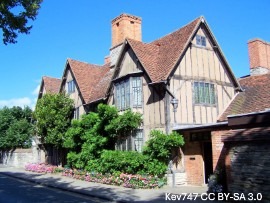
Stratford-upon-Avon home of Shakespeare's daughter is 'At Risk'
Lady Grange’s House repaired on St Kilda
.jpg)
National Trust for Scotland repairs stone cleit with link to famous island resident
Griff Rhys Jones on BBC Radio 4 Today programme
,_Green_Lane,_Derby.jpg)
The Victorian Society’s President unveiled its latest Top Ten Endangered Buildings 2026.
Need a MATE? Book your place now.
IHBC offers free webinars on applying for IHBC accreditation (Full & Associate).
UK Stained Glass Repository finds windows new homes
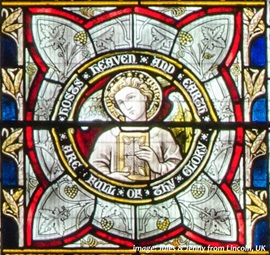
How are stained glass windows are rescued, stored and repurposed?
APPGEBE report sets high aims for quality
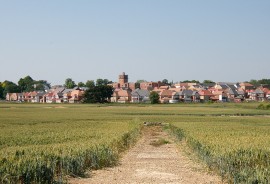
'Government must not sacrifice quality in drive to build 1.5m homes'
New measures protect Historic Shipwrecks from heritage crime

Underwater cultural heritage benefits from new HE guidance
How could the City of London skyline look in 6 years' time?

Visualisation shows approved planning applications as completed buildings
National Trust for Scotland calls for VAT cuts
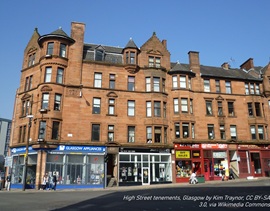
Heritage neglect is encouraged by current policies
IHBC's 'Context' Issue 186 features Industrial Heritage
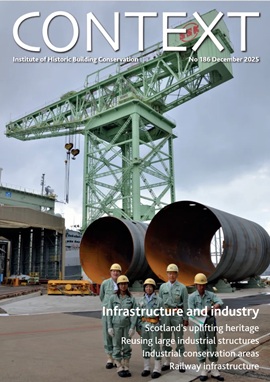
IHBC's members' journal reports on the challenges of conserving infrastructure
Book now for IHBC Annual School 2026
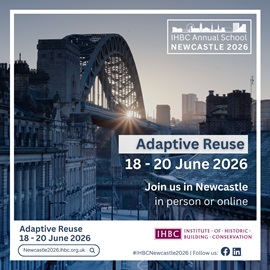
IHBC Annual School is taking place 18-20 June 2026 in Newcastle
RICHeS Research Infrastructure offers ‘Full Access Fund Call’
RICHeS offers a ‘Help’ webinar on 11 March
Latest IHBC Issue of Context features Roofing
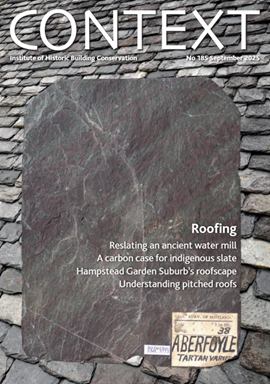
Articles range from slate to pitched roofs, and carbon impact to solar generation to roofscapes
Three reasons not to demolish Edinburgh’s Argyle House

Should 'Edinburgh's ugliest building' be saved?
IHBC’s 2025 Parliamentary Briefing...from Crafts in Crisis to Rubbish Retrofit
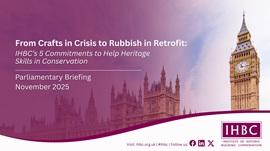
IHBC launches research-led ‘5 Commitments to Help Heritage Skills in Conservation’
How RDSAP 10.2 impacts EPC assessments in traditional buildings

Energy performance certificates (EPCs) tell us how energy efficient our buildings are, but the way these certificates are generated has changed.